The post Keeping Rack Enclosures Cool with Thermal Management appeared first on ITSENCLOSURES.
]]>Popular reasons for using thermal management, include: environments that are hot and dirty or electronics that produce a good amount of heat inside of an enclosure. For example, if the temperature outside a rack enclosure will reach 110° F or above, the internal components must be kept at a cooler temperature. However, proper cooling or ventilation is dependent on the environment and contents of the rack enclosure.
Why is cooling such an important factor in a rack enclosure solution? At the beginning of a project, if thermal management is not properly configured, several things could go wrong with the enclosed electronics. Faults in electrical components and overloads may lead to a tripped breaker, decreased life expectancy, or an unexpected equipment shutdown.
According to James Stratford, in his article, ‘The Importance of Thinking Thermal Early in the Design Process’, “It is very important to consider and deal with thermal challenges early in the design process and with assistance of specialists if you don’t have them in house. Doing this can lead to a better, more reliable end product with predictable performance that avoids the risk of components running at excessive temperatures that shorten their life expectancy and risk erratic performance.”
5 Types of Cooling Methods for Server Enclosures
- Vents/Louvers – The simplest method of enclosure cooling is utilizing a vent or louver to provide a natural convection/airflow. Natural convection cooling is simply air that is created when warm air rises and is replaced with cool air. Generally, louvers are added at the top for hot air to escape and at the bottom for cool air to be drawn into the enclosure. Is this right for your application? The maximum ambient temperature must be cooler than the maximum allowable enclosure temperature.
- Fans – Forced ventilation will move air across the enclosure to increase the cooling rate compared to vents. Fans will produce a higher air flow rate than natural convection cooling.
 Is this right for your application? The maximum ambient temperature must be cooler than the maximum allowable enclosure temperature. However, fans have the ability to filter particulate matter that should remain outside of the server cabinet.
- Heat Exchanger – Heat exchangers use a closed loop cooling system. The air inside of the enclosure is cooled and circulated without the exchange of ambient air and will also maintain the enclosure’s NEMA rating.
Is it right for your application? The maximum ambient temperature must be less than the maximum enclosure temperature. Depending on the construction, a heat exchanger may be used in a NEMA 12, 4 or 4X environment. - Vortex CoolerVortex cooling units use compressed air to cool internal components and displace the warm air that is inside of an enclosure.
Is it right for your application? A vortex cooling unit is not a closed loop system, but may be used with NEMA 12, 4 or 4X enclosures. These units also create positive pressure inside of the enclosure, so that dust and other particulate matter will not be drawn into the cabinet. There are no moving parts, so the lifetime is much longer than most thermal management systems and there is very little maintenance. - Air ConditionerAir conditioners are another common closed loop cooling system. The inside of the enclosure is cooled by an evaporator coil and circulated without mixing outside air.
Is it right for your application? Air conditioners will maintain an enclosure’s NEMA rating and they have a much wider cooling capacity compared to heat exchangers and fans. However, due to the compressor, air conditioners tend to be large in size.
Remember – consistent temperatures (inside of the cabinet) is key to creating optimal operating conditions. Inadequate cooling or air flow can destroy electronics! Knowing all of the options that exist for rack enclosure cooling, along with the benefits and limitations, will help you make the best choice for the application.
For an accurate recommendation on enclosure cooling, fill out a ‘Cooling Worksheet’ and speak to an enclosure specialist.
The post Keeping Rack Enclosures Cool with Thermal Management appeared first on ITSENCLOSURES.
]]>The post Problems Printer Enclosures Solve for Printers appeared first on ITSENCLOSURES.
]]>By deploying printer enclosures with the correct thermal management, a Zebra printer can operate in a multitude of areas. Many Zebra printers use a process called “thermal transfer” to produce small or large high-quality prints on labels. The innovative method uses a precise heated ribbon to create long lasting images on the surface of a label or tag. Zebra printers can create robust wristbands, colorful cards, product identification tags, or certification labels.
With the versatility to create durable labels, it is natural for manufacturers, distribution centers, or warehouses to utilize these printers on the factory floor. However, not all areas are created equal!
Coolers, refrigerators, chillers, or freezer conditions can cause the following issues:
- Warning – Temperature Drops Below 59°F
When the ambient temperature of the facility drops below 59°F, Zebra printers will display a warning message. Although the actual printer is not at risk of any permanent damage, the print quality may degrade or the printer will slow down considerably – based on the colder ambient temperature.
- Error – Print Heat is Too Cold
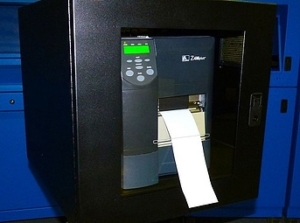
If the printer is close to a loading dock or an outside gate/garage door, it is susceptible to less than ideal operating temperatures. Essentially, the printer detects that it is unable to heat the printer head to a high enough temperature to print labels and simply ceases to work. In addition, if the environment is too cold, Zebra printers will display an error or shut down if the electrical or battery output drops to a low enough voltage level.
- Condensation
When a piece of electronic equipment is used in a cooler or freezer environment, condensation may occur. If the printer is moved in and out of a cold setting, water droplets can form, causing issues with the printer. The display screen may even be difficult to read.
The solution – A thermostatically controlled heated printer enclosure!
By deploying printer enclosures with the correct thermal management, Zebra printers can operate in a multitude of areas, as well as, extreme outdoor weather conditions. The printer enclosure will provide a reliable operating environment for the barcode printer no matter where the device resides in the factory. According to the blog, ‘Cool Solutions for the Cold Chain,’ “Label printing solutions, for instance, need purpose-built heater boxes to ensure printer functionality and also to keep the media at an effective application temperature.” The correct enclosure solution can translate into fulfilling more orders per day or increasing accuracy and productivity in a challenging area. A Zebra printer enclosure will serve as a permanent fix and eliminate the issue of harmful condensation.
The post Problems Printer Enclosures Solve for Printers appeared first on ITSENCLOSURES.
]]>The post Effects of Heat & Humidity on Computer Enclosures appeared first on ITSENCLOSURES.
]]>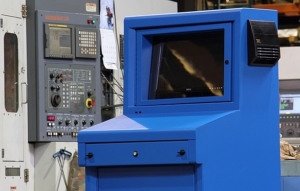
When choosing a computer enclosure, it is always a good rule of thumb to determine the necessary thermal management. An enclosure that has an internal temperature of over 95°F generally calls for a cooling system that is more powerful than a filtered fan system. Ambient air flow, through a filtered fan system, will not provide enough cooling power to regulate temperatures inside the computer enclosure within the recommended operating temperatures.
Appropriate cooling is absolutely necessary to keep electronics running smoothly and efficiently. Joe Primeau, from Acromag, describes in his blog, “Thermal Management for the Small Box,” how vents and fans can sometimes be ineffective, “Although forced convection can cool more effectively than vents alone, they share similar problems. Both methods allow moisture, dust and contaminants to enter the computer enclosure, threatening the electronics. Concern also has to be given to what happens if/when the fan fails or becomes blocked; this could quickly lead to overheating and possibly failure of the electronics.” When it comes to essential electronics, failure is not an option!
Technical specifications, published on a manufacturer website, will indicate the appropriate cooling and/or heating necessary to operate electronics within the suggested temperatures and humidity levels. It is no surprise that humidity can be extremely harmful to electronics, especially inside of a computer enclosure.
According to the article “Humidity, Its Effect on Electronic Industry and Solutions” by Uday Chakravarty, Sales Manager-International at Arctic India Sales, humidity is the root of many evils, “Humidity is a constant threat to production efficiency and product quality… Rust, mold, mildew, rot, decay, warping, stretching, lumping, caking, agglomeration and decomposition are all common enough problems encountered in our daily life. It is interesting to note that the root cause of all these problems and many more, is the presence of moisture or humidity in the air.”
If deploying electronics in a particularly humid environment, advanced systems such as a heat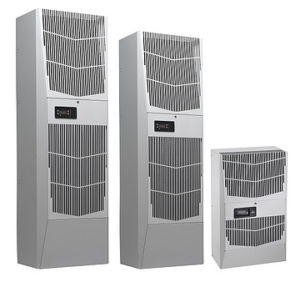 exchanger or air conditioner are smart cooling methods. Combined with a NEMA 12, NEMA 4, or NEMA 4X sealed computer enclosure, a closed loop cooling system will ensure humidity is kept outside of the cabinet and unable to harm sensitive (and often expensive) electronics.
Briskair, sums up the importance of air conditioners quite simply, “Regardless of the type of air conditioner or the job you perform, in general air conditioning offers a number of benefits… Extreme conditions such as heat and humidity can impact [electronics] overall physical intellectual activity, making even the simplest of tasks an absolute chore. Having a proper air conditioning system in place helps reduce heat and humidity, thus reducing the impact on our ability to perform and complete work tasks.”
The key to effectively managing heat in manufacturing environments is to determine the right thermal management before deploying a computer enclosure.
The three most vital things that you need to know: enclosure size (height x width x depth), ambient temperatures (highest and lowest expected temperature outside enclosure; highest and lowest temperature allowed inside enclosure), and the total equipment load in watts (sum of all heat producing equipment), which is typically available on the published manufacturers’ specs online. Enclosure construction (steel vs. aluminum vs. stainless steel) can also affect the necessary thermal management.
This simple to use formula is valuable for picking the right thermal management:
(watts x 3.413) + (1.25 x area in square feet x ∆T temperature difference in degrees F) = BTU/hr.
Watts = The total heat load inside the enclosure (the sum of all heat-producing equipment)
Area = Total exposed surface area of the enclosure expressed in square feet
∆T = The difference in temperature between the maximum expected degrees F temperature outside the enclosure and the maximum degrees F temperature allowed inside the enclosure
Always put in the time and effort to find the best thermal management that will reduce the harmful effects of heat and humidity. If the correct thermal management is not chosen in the beginning, money and productivity will be lost with every minute of downtime. Electronics’ and/or thermal management failures will end up costing more money in the long run. Choosing wisely up front will keep overhead down considerably!
The post Effects of Heat & Humidity on Computer Enclosures appeared first on ITSENCLOSURES.
]]>